
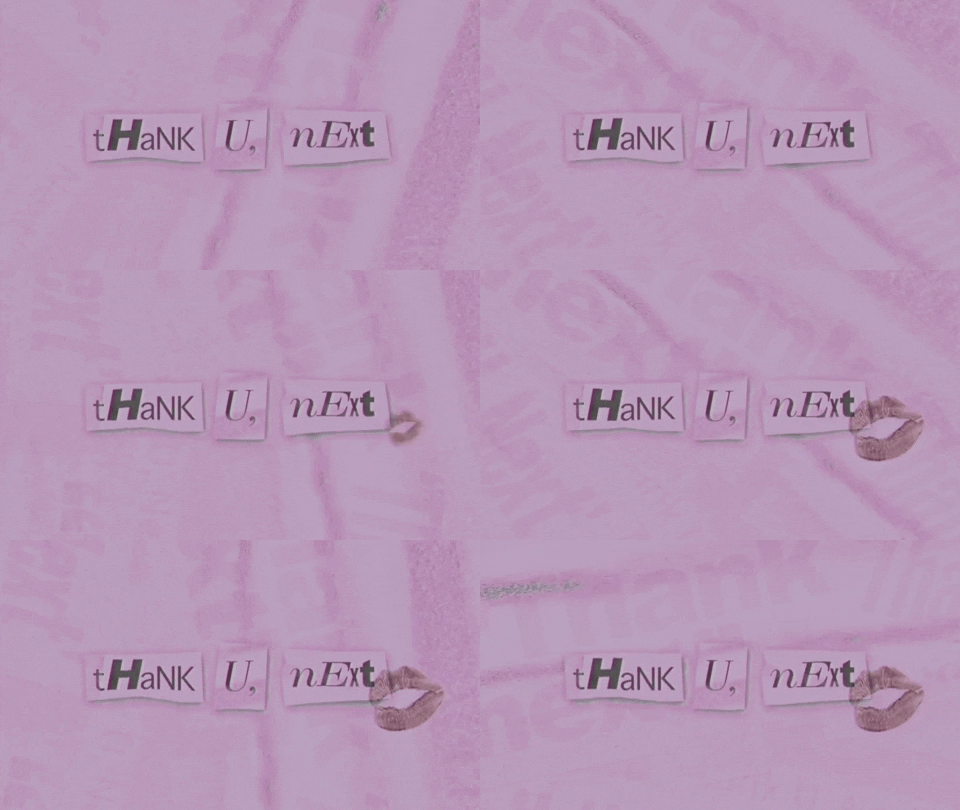
Alongside the discussion of intertextuality comes a more contemporary and accessible way to interact with text. According to theorist Vincent Leitch, who's own analyses of text operated beside Porter saying, "Its system of language, its grammar, its lexicon, drag along numerous bits and pieces --traces--of history so that the text resembles a cultural Salvation Army Outlet with unaccountable collections of incompatible ideas, beliefs, and sources" (Leitch, 35). Leitch's statement forced me to reassess texts I've recently become privy to, such as Ariana Grande's "Thank U, Next". The video works to compile several romanic comedies that my generation of ABC Family and Nickelodeon lovers are familiar with. From a first glance, the music video operates on the basic levels of intertextuality, by singing on top of famous scenes from the movies Mean Girls, Bring It On, 13 Going On 30, and Legally Blonde. Grande utilizes her audience's familiarity with these famous scenes by first, making them so accurate that they become satirical. This then, allows space for critique of LGBTQ issues (through the use of queer actors in replacement of the originals), feminism (simply by how ridiculous these films are in retrospect to the song), and millennials (by poking fun of how influenced we are by the pop cultural references of the films).
I like using "Thank U, Next" as an example of intertextuality because it's a direct link to our culture's current use and understanding of it. So often 'intertextuality' is understood on its basic levels of reference to something else--but usually not taken to understand the writer as more than an individual but, "on the sources and social contexts from which the writer's discourse arises" (Porter, 35). Porter's explanation of discourse community disrupts, in my opinion, the understanding that "intertext constrains writing" (35). Que to a couple days after the music video's release, where Grande performed on Ellen. Here, Ariana Grande performs while copying the famous ending empowering dance scene in The First Wives Club. While amazing, on more than one level, this 'reference' did confuse a lot of young people. The 1996 comedy starring Goldie Hawn and Diane Keaton, to name a few, was a bit of a jump for some people as far as--did you get it? On an analytical note, she did something very important here. Instead of repeating the name cultural references, she's utilizing more than just a couple texts. "Thank U, Next" is about past relationships and moving on with your life. Because she coupled the song between existing texts, that already belong in our culture's repertoire of opinion, reference, love, and critique Grande pulled off something much bigger then the song would have alone. The texts carefully chosen allowed her to communicate the messages of empowerment, humor, and getting on with life in ways that the over repetitive song wouldn't have been able to do solely lyrically. This opens the doors to what intertextuality, and its understanding of it, can accomplish for a seemingly mundane pop song. Being responsible for creating text that is liked between, over, and through several variances of text is complicated enough. "Thank U, Next" is an example of the writer not being "constrained" (35) by text but inspired, and extremely productive, by it.
O.K., moving on:

As an aspiring secondary English teacher I'm curious, what have been some of your experiences utilizing multiple texts in the classroom? Of course, Digital Rhetorics has already set the bar pretty high as far as multiplicity of 'types' of texts go. But, really I'm curious, what did some of you experience as far as successful use of texts?

Really great job wrapping in modern examples of intertextuality (I hate to admit it but I kinda love Thank U Next). You made an interesting point about her including more than one text in her work, how important is it to do that? Does a more complexly woven intertext mean a better quality work? I tend to think that over-referencing other works in your own work makes it lose a quality or originality. And originality is often a condition that is seen as essential in a good work of writing. I think something important about interweaving other texts into your own is that you put your own spin on it. Without adding your own style, you're simply compiling the work of others.
ReplyDeleteAs far as my own experience in the classroom with intertextuality, I honestly hadn't known much about it before. We hadn't ever explicitly discussed intertextuality as a tool/concept in writing. Though I had obviously noticed it before, I hadn't thought much about how nearly every text is connected to another one. I guess I've noticed how threads of some stories are like others. Particularly in LIT 203 last semester we read Wuthering Heights, which our professor emphasized was the base novel involving the 'Byronic hero'. Heathcliffe, the central character in the novel is the opposite of a conventional hero. He is unlikeable, abusive and violent. Yet as a reader you learn to appreciate him. He is a believable person and his actions seem to be justified. In imagining modern anti-heroes I think of Venom, he's an alien from another planet who eats people. Yet, when he pairs up with his human host he discovers that he loves Earth and strives to save it. He is also violent but eventually becomes very likable.